
Mentioned in 2 Google reviews
Tires are the only part of your car that actually touch the road, so they take a beating every single day. Heat, potholes, curbs, old age, and plain mileage all wear them down, and it adds up faster than most people think. Rubber hardens over time even if a tire still looks fine sitting in your driveway, which is why age matters just as much as tread. A nail or a screw can let air out slow enough that you do not notice anything until the pressure light pops on the dash. By then the tire has usually been running low for a while. We check tread depth, look for cracking in the sidewall, and check air pressure on all four tires before we tell you anything needs replacing, because guessing is how people end up buying tires they did not need.
Signs You Need Tire Service
- Steering wheel shakes or vibrates at higher speeds
- One tire looks lower than the others in the morning
- You hear a thumping sound as you drive
- Tread looks worn down on the edges or in the middle
- Dashboard tire pressure light keeps coming on
- Car pulls to one side when you let go of the wheel
Before we sell you a new tire, we look at what is actually wrong with the one you have. Sometimes it is a simple puncture that can be patched and sent back out on the road. Other times the tire itself is fine, but it is out of balance or the alignment is off, which is what causes that shake at highway speed or the car pulling to one side. We also check for uneven wear patterns across the tread, since those usually point to a suspension problem rather than a bad tire. A tire worn more on one edge than the other is telling you something about the car, not just itself. Replacing a tire without figuring out the real cause just means you are back here in a few months with the same complaint and another worn tire.
When a tire does need to be swapped out, the job starts with taking the wheel off the car completely. From there we break down the old tire, mount the new one, and run it on the balancing machine so it spins true without vibration. We check the valve stem while we are in there and replace it if it looks cracked or brittle, since a bad valve stem can cause slow leaks just like a nail would. If you are putting a full set of four on the car, we make sure every tire is matched for size and type so the car handles evenly instead of fighting itself at each corner. Once everything is mounted, we torque the lug nuts to spec by hand and double check pressure on all four before you ever drive off the lot.

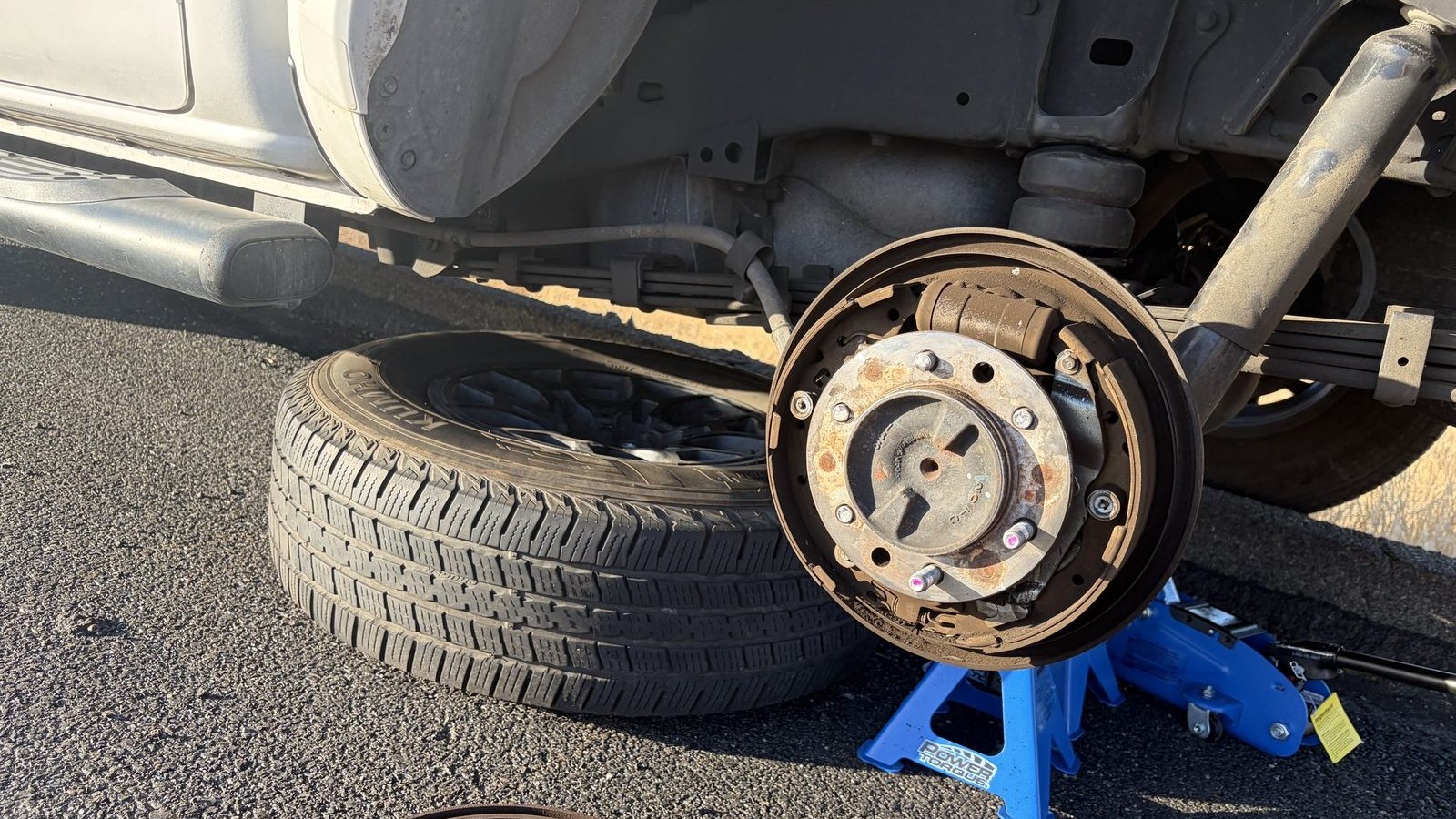

How long this takes really depends on what we are dealing with. A simple patch on a punctured tire is quick, straightforward work with not much to it. A full set of four tires paired with an alignment check takes longer, especially on a car with specialty wheels or run-flat tires, both of which need extra care during mounting. If the rim itself is bent or damaged from hitting a pothole hard, that adds another step to the job, since a tire will never hold air right on a bent wheel no matter how good the tire is. Older vehicles with rusted lug nuts or corroded wheels can also take more time to get apart safely without rounding off hardware or damaging the wheel in the process.
If you are driving around with a slow leak, keep an eye on your tire pressure and add air as needed until you can get the car looked at properly. Do not just fill it once and forget it, since a slow leak keeps leaking. Avoid high speeds if the car feels like it is shaking underneath you, since that shake can wear the tire down faster and may be pointing to a bigger problem than just the tire. If a tire goes completely flat, do not try to drive on it, not even a short distance down the road. Driving on a flat tire can ruin both the tire and the wheel, turning a simple patch job into a full tire and possibly a wheel replacement.
Tire problems rarely show up out of nowhere. Most of the time there are small warning signs before a tire actually fails, like a faint vibration, a slight pull to one side, or a tire that seems to need air more often than the others. Catching those early usually means a smaller fix, like a patch or a balance, instead of a tire that blows out on the road. Weather plays a role too, since cold snaps drop tire pressure fast and hot pavement in summer speeds up rubber wear on top of normal mileage. Checking pressure regularly, even just with a cheap gauge in the glovebox, catches a lot of these problems before they turn into something worse or leave you stuck on the shoulder.
We handle tire work for drivers throughout Florence and the surrounding area, including Elsmere, Union, Erlanger, Crestview Hills, Edgewood, Lakeside Park, and Villa Hills. Whether it is one tire with a nail in it or a full set that is finally worn out, we walk through the same process every time, checking tread, pressure, and the wheel itself before anything gets replaced. We also handle towing for cars that cannot be driven in safely, so a flat or a damaged wheel does not have to turn into a bigger ordeal getting the car to us. If something feels off with your tires, whether it is a shake, a pull, or a tire that keeps losing air, call us at 859-692-3981 and we can talk through what you are noticing and figure out next steps.
What to Tell Us When You Call
- Year, make, and model of your car
- Which tire or tires are giving you trouble
- Any shaking, pulling, or noise you have noticed
- If you want a patch, a single tire, or a full set

 Supercanic